


The Storm You Didn’t See Coming: Why We Miss the Signs Until It Breaks
There’s something we all do—quietly, unconsciously, and often for far too long. We ignore the early signs. In relationships, at work, and within ourselves, we wait until something breaks… and then we ask, “How did it get this bad?”
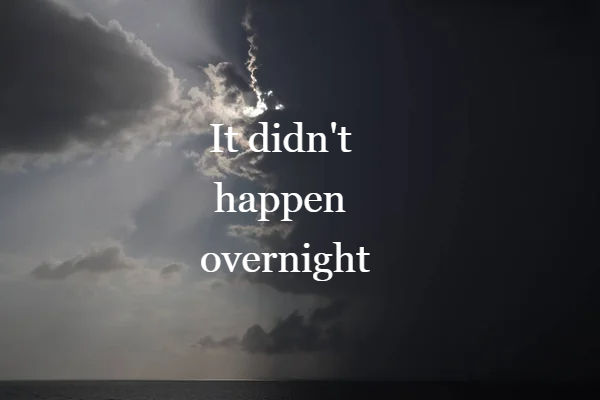
But nothing in life breaks overnight. It builds.
Think about a storm. A hurricane doesn’t just appear out of nowhere. Conditions shift slowly—pressure changes, temperature rises, energy begins to circulate. Most of it is invisible to the untrained eye, until one day it becomes undeniable.
Relationships work the same way. So do teams. So do organizations. So do we.
A conversation avoided here, a need unmet there, a frustration dismissed, a pattern repeated. Individually, they don’t seem catastrophic. But collectively, they create pressure. And pressure doesn’t disappear—it builds until it releases.
We tend to focus on the moment of impact. The argument. The betrayal. The resignation. The breakdown. We label it, judge it, and assign blame. But what if that moment isn’t the problem? What if it’s the result?
History gives us a powerful lens for understanding this. When we look back, we can clearly see moments where entire groups of people participated in systems that, over time, caused immense harm—whether it was the Holocaust, the burning of those accused of witchcraft, the enslavement of human beings, or even the crucifixion of a man whose message challenged the norms of his time. From where we stand now, it’s easy to ask, “How did that happen?” It’s easy to believe we would have seen it differently, that we would have questioned more, that we would have done something to stop it.
But history shows us something uncomfortable: humans are capable of normalizing systems that, over time, no longer serve humanity. The danger isn’t in the past—it’s in assuming we would recognize it if it were happening now.
This isn’t about blame. It’s about awareness. Because the same pattern shows up in our everyday lives.
We follow unspoken rules in relationships. We accept behaviors in the workplace. We adopt beliefs about success, communication, and roles—often without ever examining where they came from. And when something feels off, we override it. We tell ourselves, “This is just how it is,” or “Every relationship is hard,” or “Work is supposed to be stressful.” We normalize it… until the storm hits.
The truth is, most people don’t realize they are in a storm until they are standing in the damage—not because they lack awareness, but because they have been conditioned not to question what they’ve been taught is normal.
I see this clearly when I reflect on my own patterns. For most of my life, I struggled to get people to truly hear me—not because I didn’t have insight, but because I had learned to communicate from a place others hadn’t yet learned to recognize. I grew up in an environment where emotions ran high—addiction, conflict, unpredictability—and in that environment, I developed a skill very early: I learned to read energy. I noticed the smallest shifts in tone, posture, and expression. I looked beyond what was being said to understand what was actually being felt.
It became second nature to me—not because I was better at it, but because I was in an environment where it was necessary. When you grow up in unpredictability, you learn to read what isn’t being said. For others, that awareness often develops later—through experience or reflection.
I remember being told more than once, “Don’t psychoanalyze me,” when I would ask questions or reflect back what I was noticing. At the time, I took that as a sign I was doing something wrong—like I needed to stop looking so closely. What I understand now is that I was seeing something the other person wasn’t ready to see yet. And when awareness isn’t shared, it can feel uncomfortable instead of helpful.
I wasn’t wrong for seeing it—I just hadn’t learned yet how to help others see it with me.
That realization changed everything.
I stopped trying to convince, and I started trying to translate.
Instead of saying, “Here’s what’s wrong,” I began asking myself, “What does this look like?” Sometimes it looks like a storm forming. Sometimes it looks like a car dashboard lighting up.
Think about your body like a vehicle. Your emotions are not problems—they are signals. Frustration, sadness, anxiety—these are your system’s way of saying, “Something needs your attention.” Just like a check engine light, you can ignore it. You can keep driving. You might even make it pretty far. But eventually, something will break.
The same is true in relationships and in work. When communication breaks down, that’s a signal. When resentment builds, that’s a signal. When people disengage, that’s a signal. And if we don’t stop to understand the signal, we will end up reacting to the breakdown instead of preventing it.
This is why reflection matters—not surface-level reflection, but true root cause analysis. Not simply asking, “What just happened?” but instead asking, “What has been happening that led to this?”
This applies to a marriage. It applies to a team. It applies to your own internal world.
Because once you can see the pattern, you are no longer at the mercy of the storm.
You can respond earlier. Speak sooner. Adjust before the pressure builds.
And if you do find yourself standing in the aftermath of a storm, you don’t just clean up the damage—you study it. You ask what the early signs were, what you ignored, and what you didn’t yet understand at the time. Not to assign blame, but to gain clarity.
Because the goal isn’t to avoid storms entirely. That’s not how life works.
The goal is to recognize them sooner… and understand them more clearly.
Because what we don’t question, we repeat.


Comments